Weekly Inquiry Analysis
用 AI 把"周度询价分析 + 议价跟进"
从手工 Excel 变成可规模化的产品能力
Weekly Inquiry Analysis
Transform weekly inquiry analysis
from manual Excel into scalable AI-powered capability
四个部分
一条完整的叙事路径,从需求到落地
整体需求
Weekly Inquiry Analysis:流程、数据、痛点
产品价值
当下收益 + 三阶段进化价值
整体设计
产品流程图、UI 结构、AI 交互
扩展与预留
演进路线、可复用能力、关键决策
Four Parts
A complete narrative from requirements to implementation
Requirements
Workflow, data structure, pain points
Value
Immediate ROI + 3-stage evolution
Design
Product flow, UI structure, AI interaction
Extension
Roadmap, reusable capabilities, decisions
业务背景与目标
每周两次的询价分析,目标是"可规模化的价格优化与份额提升"
HQ 创建询价
在 SAP/Hana 中创建 Collective Number,每个询价包含几十到上百个 item
数据流转
导出 List A(询价总览)+ List B(item-level 比价明细)
中国团队分析
每周 2 次周度分析,提升中国供应商份额、推动报价优化
快速识别机会
- 份额提升识别中国供应商可争取的 item
- 价格谈判发现可谈价的询价机会
输出行动方案
- 跟进清单自动生成待办任务列表
- 邮件草稿德/英双语议价邮件模板
沉淀历史数据
- 跨周趋势追踪价格与份额变化
- 规则复盘评估议价策略效果
Context & Goals
Twice-weekly analysis aiming for scalable price optimization and share uplift
HQ Creates Inquiry
Create Collective Number in SAP/Hana, each inquiry contains dozens to hundreds of items
Data Flow
Export List A (Overview) + List B (Item-level comparison)
China Team Analysis
Twice weekly analysis to improve China supplier share and quotation outcomes
Identify Opportunities
- Share UpliftFind items where China suppliers can compete
- NegotiationDiscover renegotiable pricing opportunities
Produce Actions
- Task ListAuto-generated follow-up tasks
- Email DraftsDE/EN negotiation templates
Build History
- TrendsTrack price and share changes over time
- ReviewEvaluate negotiation strategy effectiveness
现状流程与主要痛点
流程可执行,但高度依赖人力与经验
导出概览
List A → 逐个 inquiry 下钻 SAP 看 item-level 比价
人工判断
凭经验判断每个 item 的价格合理性
手工沟通
手动写邮件催报、议价
手工成本高
每周约 1.5–2 FTE days,且无法覆盖所有 inquiry
判断依赖经验
缺少统一规则与口径(价格合理性、份额提升点)
沟通全手工
重复劳动、口径不统一、难复盘
7开头定制件被放弃
能力瓶颈导致潜力被放弃,几乎不做分析
Current Process & Pain Points
Executable workflow, but highly dependent on manual effort
Export Overview
List A → drill into SAP per inquiry for item-level comparisons
Manual Labeling
Judge price reasonableness based on experience
Manual Communication
Write emails manually to chase quotes and negotiate
High Manual Effort
1.5–2 FTE days/week, still can't cover all inquiries
Judgement Depends on Experience
No unified rules & definitions for pricing logic
Communication is Manual
Repetitive, inconsistent, hard to review
"7*" Custom Items Ignored
Capacity constraint hides potential share growth
核心数据对象:两张表驱动全流程
List A 负责"入口索引",List B 负责"深度分析",通过 Collective Number 关联。
List A:Weekly Inquiry Overview
粒度:Collective Number回答:本周有哪些 inquiry?谁负责?状态如何?
List B:Item-level Offer Comparison
粒度:Item + Supplier回答:中国供应商 vs 最优供应商差多少?是否可谈/异常?
统一模板
固定列名与顺序,price_final 明确定义(EP/YW/BP/PRI)
导入校验
字段类型检查、空值验证、collective_number 不为空
去重 & 版本追踪
按 collective number 自动去重、更新状态、审计日志
可审计
每条数据可追溯来源、导入时间、修改记录
Core Data Objects: Two Lists Drive the Workflow
List A handles entry indexing; List B powers deep analysis, linked via Collective Number.
List A: Weekly Inquiry Overview
Grain: Collective NumberAnswers: which inquiries this week? owner? status?
List B: Item-level Offer Comparison
Grain: Item + SupplierAnswers: gap vs best supplier? negotiable / anomalous?
Unified Template
Fixed columns & order, defined price_final (EP/YW/BP/PRI)
Import Validation
Type check, null validation, collective_number required
Dedup & Versioning
Auto dedup by collective_number, status update, audit log
Auditable
Traceable source, import time, change history per row
从手工 Excel 到规模化产品能力
把"人力密集的分析工作"转化为可复用、可审计、可规模化的智能系统
效率提升
- 导入自动化减少截图/复制粘贴
- 智能排序Top 机会清单自动生成
- 批量处理邮件草稿一键生成
质量保障
- 规则引擎价差/历史价/材料价统一口径
- 可追溯每条建议都有数据依据
- 可复盘行动→结果→规则迭代
业务结果
- 覆盖率↑纳入 7 开头定制件分析
- 响应速度↑更及时的跟进节奏
- 成本优化规模化份额提升抓手
From Manual Excel to Scalable Product Capability
Transform labor-intensive analysis into reusable, auditable, and scalable intelligent systems
Efficiency
- Auto ImportReduce screenshots/copy-paste
- Smart RankingTop opportunities auto-generated
- Batch ProcessOne-click email drafts
Quality
- Rule EngineUnified price gap/historical/material
- TraceableEvery recommendation has evidence
- ReviewableAction→Outcome→Rule iteration
Outcomes
- Coverage↑Include "7*" custom inquiries
- Speed↑More timely follow-up cadence
- Cost OptScalable share improvement
三阶段进化路线:价值递增、风险可控
从"可用"到"可自动运行",AI 参与度逐步提升。
先可用
数据基建 + 规则可用 + 界面成型
- AI:解释、草稿、辅助建议
- 人:筛选、决策、确认发送
更懂业务
自然语言探索,沉淀分析路径
- AI:问答、归因、总结
- 人:提出问题、形成模板
可自动运行
任务链自动化 + 关键节点人审
- AI:触发、生成清单、自动草稿
- 人:阈值审批、最终复核
3-Stage Evolution: Increasing Value, Controlled Risk
From usable to automated, AI involvement rises in steps.
Make it usable
Data foundation + usable rules + UI in place
- AI: explanations, drafts, assistant suggestions
- Human: filter, decide, approve sending
Learn the business
Natural language exploration, capture analysis patterns
- AI: Q&A, root-cause, summaries
- Human: ask questions, create templates
Run as tasks
Task chains + human approval at critical points
- AI: trigger, generate action list, auto drafts
- Human: threshold approvals, final review
Weekly Inquiry Analysis(MVP 闭环)
闭环是主目标:先把“导入 → 分析 → 建议 → 草稿 → 确认 → 复盘”做深做稳。
这条闭环是阶段一的“产品骨架”,下面的能力全部围绕它展开。
List A/B 导入与数据质量
以“用户上传的文件”为入口:字段映射 → 校验 → 去重 → 导入日志。
规则引擎驱动的分析骨架
价差 / 历史价 / 材料价(material_ratio + 钢价)形成可解释结论与标签。
Dashboard → 下钻详情的主线动线
本周机会雷达做排序/筛选/预警;从 collective 下钻到 item 与 supplier quotes。
AI 解释与邮件草稿(半自动)
AI 输出解释与草稿,人做阈值确认;发送后进入记录与复盘。
Weekly Inquiry Analysis (MVP Loop)
The loop is the product core: deepen “import → analyze → recommend → draft → approve → review”.
This loop is the Phase-1 backbone; every capability below exists to make it reliable.
List A/B import and data quality
Use “Uploaded Files” as the entry: mapping → validation → dedup → import logs.
Rule-engine analysis backbone
Price gap / historical price / material cost (material_ratio + steel price) power explainable tags.
Dashboard → drill-down as the main path
Weekly radar handles rank/filter/alerts; drill from collective to item and supplier quotes.
AI explanations and email drafts (semi-automatic)
AI produces explanations and drafts; humans approve at thresholds; sending feeds review.
产品流程图
上:系统自动化流程,下:用户审批流程。
Product Flow
Top: system automation. Bottom: user + approval track.
UI 结构(阶段一:人机协作)
三列布局 + LLM 协作区作为"辅助层"。
整体验图(3 列)
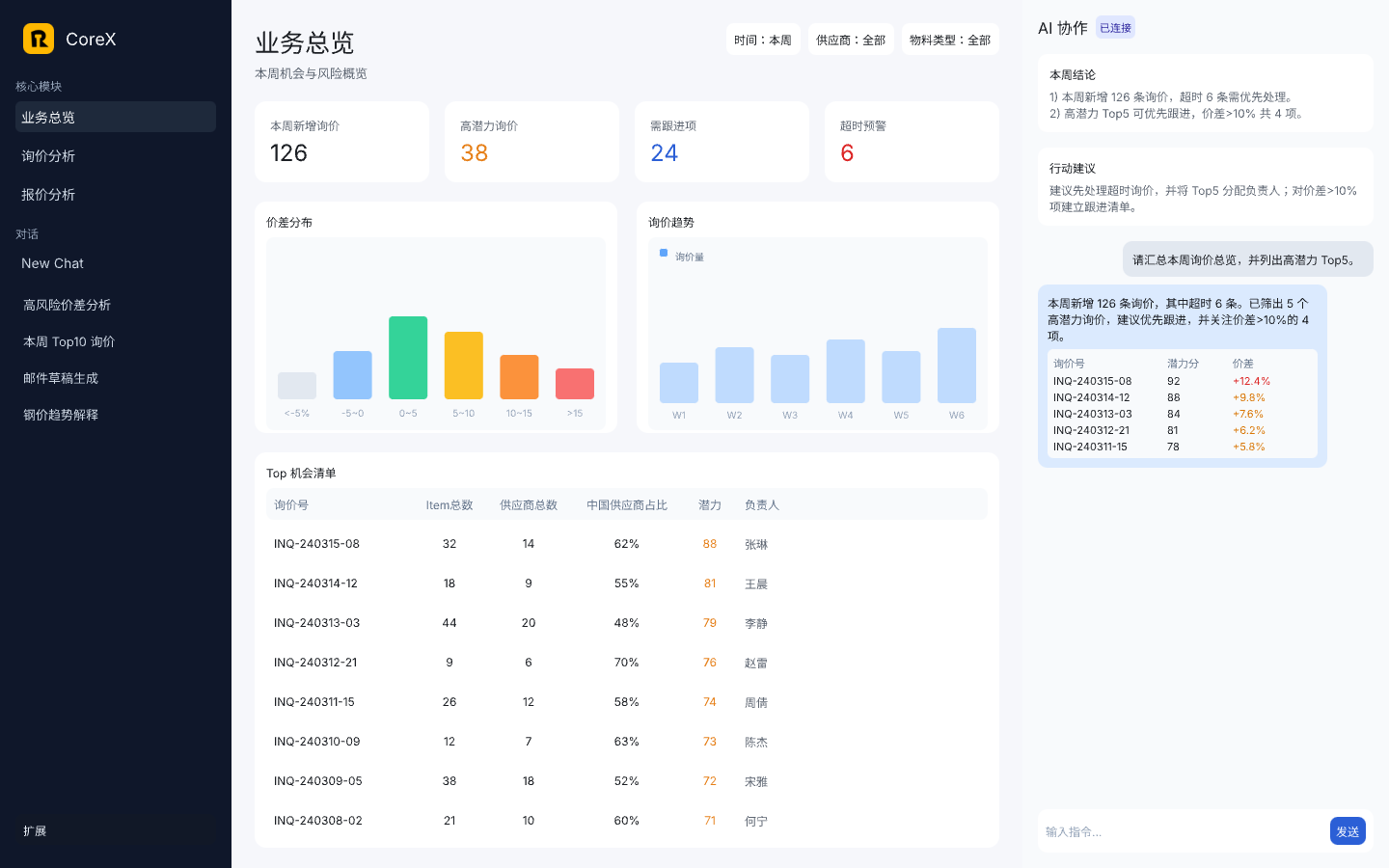
关键页面清单(9 个核心页面)
Dashboard(指标卡片 + 图表)
表格(筛选/排序/高亮)
表格(筛选/排序/高亮)
新对话入口 + 任务卡片
完整对话页面
表格(参考询价表)
Dashboard(价格趋势)
文件列表与预览
邮件记录 + 日期筛选
UI Structure (Phase 1: Human-AI Collaboration)
Three columns with the LLM copilot as an auxiliary layer.
Three-column layout
Key Screens (9 Core Pages)
Dashboard (metrics cards + charts)
Table (filter/sort/highlight)
Table (filter/sort/highlight)
New chat entry + task cards
Full conversation pages
Table (reference inquiry records)
Dashboard (price trends)
File list and preview
Email records + date filter
安全与治理 可控 · 可审计 · 可追溯
企业级 AI 系统的安全基石:明确的权限边界、完整的操作日志、全链路的决策追溯
可控
工具权限边界明确,读数据/写系统/发邮件分级控制,确保 AI 在授权范围内运行
可审计
每一步输入/输出/决策都有日志可追溯,形成完整的操作审计链路
可追溯
从数据输入到决策输出的完整链路追溯,支持决策复盘与责任界定
私有化部署
前端静态资源 + FastAPI 后端
网络边界
内网环境,清晰的网络隔离
数据隔离
角色/采购员/项目级权限
Security & Governance Control · Auditability · Traceability
Enterprise AI security foundation: clear permission boundaries, complete operation logs, full decision traceability
Control
Clear tool permission boundaries with tiered control for data reading, system writing, and email sending
Auditability
Every input, output, and decision is logged and traceable, forming a complete audit trail
Traceability
Complete chain from data input to decision output, supporting decision review and accountability
Private Deployment
Static frontend + FastAPI backend
Network Boundary
Intranet with clear isolation
Data Isolation
Role/buyer/project-level access
演进路线(项目节奏)
先数据,后规则;先半自动,后任务化。
- ✓ 业务流程梳理(AS-IS → TO-BE)
- ✓ 数据对象设计(InquiryHeader、InquiryItem、SupplierQuote)
- ✓ 三列 UI 原型(导航 + 主视图 + LLM 协作)
- 数据库建表与字段定义
- Excel 导入向导:映射、校验、去重、日志
- List A/B 数据导入与关联
- 基础报表:询价列表、Item 明细、供应商对比
- 价格合理性:成本模型(钢材价 × material_ratio)
- 竞争力评估:中国供应商 vs 最优价差
- Inquiry 评分:按可谈降价比例 + 供应商数排序
- Dashboard:机会雷达、筛选/排序/预警
- AI 草稿:解释 + 邮件草稿(半自动)
- 自然语言问答:智能查询与归因分析
- 任务驱动自动化:触发、生成清单、关键节点人审
- SAP/Hana 接口:替代 Excel,实时同步
- 审批阈值:金额/品类/供应商等级触发复核
Roadmap (Delivery Phases)
Data first, rules next; semi-automatic before task automation.
- ✓ Workflow analysis (AS-IS → TO-BE)
- ✓ Data model design (InquiryHeader, InquiryItem, SupplierQuote)
- ✓ 3-column UI prototype (nav + main view + LLM copilot)
- Database schema and field definitions
- Excel import wizard: mapping, validation, dedup, logs
- List A/B data import and linking
- Baseline reports: inquiry list, item details, supplier comparison
- Price reasonableness: cost model (steel price × material_ratio)
- Competitiveness: China supplier vs best price gap
- Inquiry scoring: rank by negotiable ratio + supplier count
- Dashboard: opportunity radar, filter/sort, alerts
- AI drafts: explanations + email drafts (semi-auto)
- Natural language Q&A: smart queries and root-cause analysis
- Task-driven automation: trigger, generate lists, human approval
- SAP/Hana integration: replace Excel, real-time sync
- Approval thresholds: amount/category/supplier tier triggers review
需要对齐的 关键决策
对齐口径与责任,才能进入规模化自动化
数据责任与自动化边界
- List A/B 数据 owner、导出频率与位置、模板维护人
- material_ratio 与 steel price 数据源与维护机制
- 自动发送边界:第一阶段仅草稿 vs 自动发送?
角色与权限体系
- 管理员 vs 采购员权限边界:配置/审批/执行/查看
- 权限颗粒度:字段级编辑、规则级发布、邮件发送
- 职责隔离与审计:关键操作必须留痕
Dashboard 信息架构
- 核心 KPI:份额提升潜力、可谈价金额、节省金额
- 工作视图:本周待跟进清单、审批队列、异常预警
- 趋势与对比:周度趋势、品类/采购员/供应商分布
询价分析 / 报价分析页面
- 核心字段:Collective No、item、物料组、供应商、价格拆分
- 补充字段:material_ratio、steel index、交期/MOQ
- 筛选条件:时间/品类/采购员/供应商层级/差异阈值
评分逻辑与合理性验证
- 价格合理性:与历史/同类/钢价基准的偏离度
- 中国竞争力:报价差距、响应速度、质量/交付指标
- 机会评分:权重与阈值需基于历史回测校准
业务口径
- 价格口径:EP/YW/BP/PRI 哪个作为 price_final?是否包含运费/关税/折扣?
- 阈值口径:5%/10%/20% 等规则从哪来?如何版本化?
- 材料占比口径:按品类定义默认占比,允许按物料号覆盖
Key Decisions to Align
Align definitions and ownership to unlock scalable automation
Data Ownership & Boundaries
- List A/B data owner, export cadence and location, template owner
- Data sources & maintenance for material_ratio and steel price
- Auto-send boundary: drafts-only vs auto-send? thresholds and approvals
Roles & Permissions
- Admin vs buyer: split of configure/approve/execute/view
- Granularity: field-level edits, rule publishing, email send
- Segregation of duties & audit: key actions must be traceable
Dashboard Design
- Core KPIs: share uplift potential, negotiable amount, savings
- Work view: weekly follow-up list, approval queue, alerts
- Trends & distribution: weekly trend, by category/buyer/supplier
Analysis Pages
- Key fields: collective no, item, material group, supplier, price breakdown
- Enrichments: material_ratio, steel index, lead time/MOQ
- Filters: time, category, buyer, supplier tier, variance threshold
Scoring & Validation
- Price reasonableness: deviation vs history/peers/steel index baseline
- China competitiveness: price gap, response speed, quality/delivery weights
- Opportunity score: calibrate weights/thresholds via backtesting
Business Definitions
- Price definition: which field is price_final (EP/YW/BP/PRI)? include freight/duty/discounts?
- Threshold rules: where do 5%/10%/20% come from? how are they versioned?
- Material ratio: default by category with per-part overrides